We’ve mapped out and analyzed wireless coverage from the nation’s “Big 3” largest networks—AT&T, T-Mobile, and Verizon—to determine where they provide the strongest signals.
Using this data, we can help you pinpoint the best service at your home address or any other areas you like to travel. You can also check out our coverage maps and state coverage pages to figure out which network is best for your general region.
Which carrier has the best cell phone coverage in your area?
You can enter your address in our zip code coverage checker to see the network that offers the best coverage in your area.
If you live in a city or area that’s served well by multiple networks, you may wonder how they all stack up. Compare each carrier’s coverage head-to-head in our matchups below:
T-Mobile has the nation’s largest 5G network, while Verizon is dominant in 4G LTE.
You can see how each major carrier stacks up by its coverage percentages in the table below. Don’t be surprised that the 5G national coverage percentages seem small. Carriers place 5G towers in urban areas to cover as many people as possible, while 4G LTE towers and their long-range waves are used to cover larger areas.
Percentage of nationwide network coverage
| Network | 4G LTE Coverage | 5G Coverage |
|---|---|---|
| Verizon | 70% | 21% |
| AT&T | 68% | 41% |
| T-Mobile | 62% | 49% |
How to choose the best network for you
Selecting the best network for you doesn’t have to be hard. Just follow these simple steps:
- Check your zip code in our checker above to find the top networks where you live.
- Compare the “Big 3” network strengths below.
- Consider a smaller MVNO carrier that operates on your top network to save money.
T-Mobile coverage
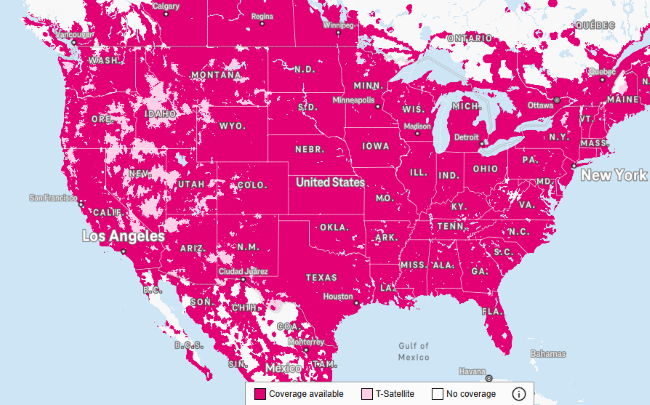
Image: T-Mobile
T-Mobile has the largest 5G network coverage in the U.S.
Key T-Mobile coverage facts:
- Largest 5G network (53% of nation)
- Smallest 4G LTE network (62% of nation)
- T-Mobile 5G UC network offers fast speeds
- T-Satellite coverage available
T-Mobile’s coverage offers the nation’s largest 5G network, blanketing 53% of the country. Most of its 5G coverage is centered in cities and suburban areas. This includes the T-Mobile 5G Ultra Capacity (5G UC) network, which uses the carrier’s mid-band and millimeter-wave towers to provide the fastest 5G speeds.
Why is T-Mobile’s 5G network bigger than Verizon's and AT&T's? It’s because T-Mobile primarily relies on low-band 5G towers outside of cities. This technology lets 5G signals travel farther and cover wide distances, but that range comes at a cost of slower speeds. Verizon’s 5G network is primarily built using ultra-wideband towers, offering lightning-fast speeds, but a much smaller coverage area.
Does T-Mobile offer reliable 4G LTE coverage?
Yes, T-Mobile’s 4G LTE coverage is reliable overall, but it’s slightly less reliable than Verizon's and AT&T's.
Despite having the nation’s largest 5G network, T-Mobile’s 4G LTE network is actually the smallest, covering just 62% of the country. That means customers in rural areas may struggle to get a signal, and there are tiny pockets of T-Mobile dead zones scattered across the nation.
T-Satellite keeps you connected where others can't
T-Satellite is T-Mobile’s satellite coverage powered by a partnership with Starlink. It allows customers to connect to the Starlink constellation for text messaging and limited data when in areas where T-Mobile’s ground network isn’t available.
It’s only included for free on the T-Mobile Experience Beyond plan. For customers on other T-Mobile plans—and even other carriers—it’s available as a $10/month add-on.
Our experience on the T-Mobile network
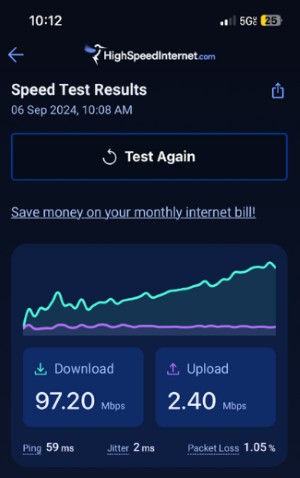
the T-Mobile 5G UC network.
Image: Daphne Kelly
Our WhistleOut experts have had extensive experience testing T-Mobile’s network, both on T-Mobile’s plans and its MVNOs.
In the image above, you can see our team member Daphne Kelly recorded speeds around 100Mbps on T-Mobile’s 5G UC network in downtown Boise, Idaho. That’s the kind of average speed you’ll see with T-Mobile’s 5G, but it can get even faster.
We’ve also tested multiple T-Mobile MVNOs, including Mint Mobile, US Mobile, and Tello. These smaller carriers use the T-Mobile network, offering identical coverage and fast speeds.
When testing T-Mobile’s network on a Mint Mobile plan, Angelo Ilumba noted, “I never saw speeds dip down below 200Mbps, with peak speeds reaching as fast as 600Mbps.” He also reported he had excellent coverage in his area of suburban Southern California.
Despite the 5G speeds, T-Mobile’s coverage isn’t perfect. Our testing has shown the carrier sometimes struggles to provide a signal in rural areas.
Which carriers operate on the T-Mobile network?
You don’t have to buy a T-Mobile plan to get access to its impressive 5G network. T-Mobile has more MVNOs using its network than any other major carrier. There are dozens of choices, including popular options like Mint Mobile, Ultra Mobile, and Tello. You can score an unlimited plan for this network with Mint for as cheap as $30/month.
The dropdown box below has our picks for the best T-Mobile MVNOs for your money. You can also check out our T-Mobile MVNOs guide for the full list of smaller carriers we track.
These carriers use T-Mobile's extensive 5G network coverage to offer excellent service. Compare their features below:

Mint Mobile
Best Value (Bulk Payment)
WhistleOut Rating: 4.5 / 5.0
Discounted rates with prepayment of 3, 6, or 12 months of service.

Google Fi
Designed for Global Travel
WhistleOut Rating: 4.0 / 5.0
Flexible plans with seamless international data access in over 200 destinations.

Tello
Cheapest for Low Data
WhistleOut Rating: 4.0 / 5.0
Highly customizable, low-cost plans including an affordable unlimited option with 50GB of data.

US Mobile
Customizable Network Choice
WhistleOut Rating: 4.0 / 5.0
Select between the Verizon (Warp), T-Mobile (Light Speed), or AT&T (Dark Star) networks.

Red Pocket
Access to All Major Networks
WhistleOut Rating: 3.0 / 5.0
Provides competitive annual plans and access to all three major US carrier networks.

Ultra Mobile
Focus on International Calling
WhistleOut Rating: 3.0 / 5.0
Provides international calling benefits and low-cost global communication plans.
Verizon coverage

Image: Verizon
Verizon’s 4G LTE network is reliable and widely available
Key Verizon coverage facts:
- Largest 4G LTE network (70% of nation)
- Smallest 5G network (13% of nation)
- Verizon 5G UW limited to select cities
The Verizon network’s strongest feature is that it offers the nation’s largest 4G LTE coverage area. While 5G offers faster speeds, 4G LTE is still the backbone of the country’s wireless networks since it's so widespread. This means that Verizon offers some of the most reliable coverage of any carrier. You can find a signal whether you’re in a major city or in a small town, or traveling anywhere in between.
What is Verizon’s 5G Ultra Wideband network?
While Verizon dominates 4G LTE, it has the nation’s smallest 5G network. That said, virtually all of its 5G network is made up of wideband towers, providing incredibly fast speeds. Verizon calls this its 5G Ultra Wideband network, and it's found almost exclusively in major cities across the nation.
The carrier doesn’t rely on low-band towers to extend its 5G coverage like T-Mobile or AT&T. Outside of urban areas, you won’t be able to access Verizon’s 5G network.
Our experience on the Verizon network
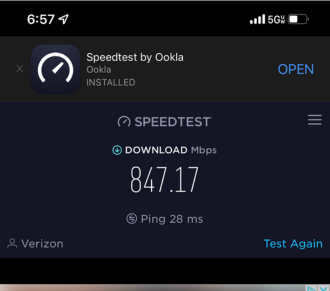
Verizon 5G UW network.
Image: Angelo Ilumba
While testing the Verizon 5G UW network, we saw lightning-fast data speeds. The carrier’s coverage is also excellent, offering a steady signal throughout our tests, no matter where we traveled.
As you can see in the screenshot above, Angelo Ilumba found a download speed of 847Mbps with his Verizon plan in Southern California. He reported that in all of his years of testing carriers, that was the fastest wireless download speed he’d ever seen.
We’ve also seen incredibly fast speeds and widespread coverage on Verizon’s MVNOs. I recently saw 5G data speeds of 357Mbps when testing MobileX in eastern South Carolina, and Angelo saw speeds of 150Mbps on Visible in Southern California.
In rural regions, you’ll be on Verizon’s expansive but slower 4G LTE network. As Angelo explained, “You're not always going to get the fastest data speeds with Verizon, especially if you're on the 4G LTE network, but you'll usually have adequate speeds for just about everything you need to do on your phone.”
What carriers operate on Verizon’s network?
There’s no way to avoid it: Verizon is expensive. Luckily, its MVNOs include some of the most price-conscious smaller carriers on the market, including Visible, Twigby, and MobileX. Plus, offering low prices doesn’t mean you’re getting poor service and fewer features. Some Verizon MVNOs—like Visible—offer plans with unlimited 5G data and unlimited mobile hotspot use for as cheap as $25/month.
Check out our favorite Verizon MVNOs in the dropdown box below, or head to our Verizon MVNOs guide to see the full list of carriers.
These carriers offer Verizon's massive 4G LTE network and lightning-fast 5G data speeds. Compare their features below:

Visible
Cheap Unlimited Data & Hotspot
WhistleOut Rating: 4.5 / 5.0
Unlimited data and unlimited hotspot on Verizon's 5G network starting at $25/month.
US Mobile
Customizable Network Choice
WhistleOut Rating: 4.0 / 5.0
Select between the Verizon (Warp), T-Mobile (Light Speed), or AT&T (Dark Star) networks.

Twigby
Best Value for Light Users
WhistleOut Rating: 4.0 / 5.0
Affordable limited plans on Verizon's network starting at $5/month.
Red Pocket
Access to All Major Networks
WhistleOut Rating: 3.0 / 5.0
Provides competitive annual plans and access to all three major US carrier networks.
AT&T coverage
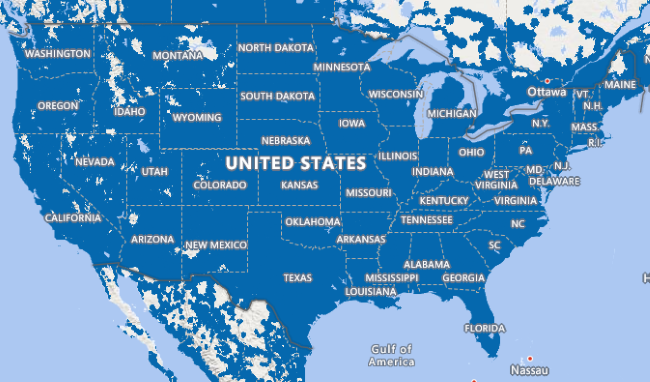
Image: AT&T
AT&T is the best network for overall reliability
Key AT&T coverage facts:
- Second-largest 4G LTE network (68% of nation)
- Second-largest 5G network (41% of nation)
- AT&T 5G+ available in select cities
The AT&T network offers a balanced coverage map and excellent reliability. Its 4G LTE network is widespread enough to give rural customers excellent coverage, and its 5G network is large enough to include most suburban areas and smaller towns.
Where is AT&T’s 5G network available?
Though not as large as T-Mobile’s, AT&T’s 5G network is still widespread. You’ll find it centered in cities and smaller towns across the country. In fact, it’s even the only carrier to offer 5G coverage in Alaska.
AT&T’s 5G+ network is its mid-band and millimeter-wave towers that offer the carrier’s fastest 5G speeds. While T-Mobile’s 5G network does cover large areas, the 5G+ network is generally limited to major cities.
Our experience on the AT&T network
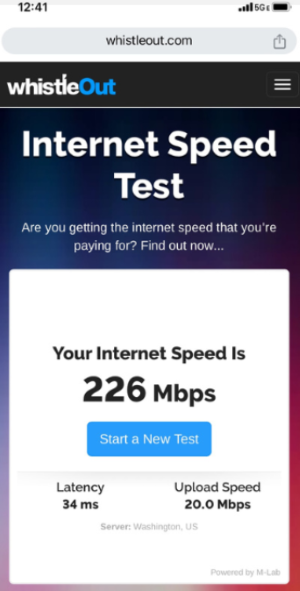
Image: Kevin Kearney
During our testing of AT&T’s networks, our experts have seen fast 5G speeds. Kevin Kearney saw download speeds in excess of 200Mbps in cities like Philadelphia, PA, and Oceanside, CA.
AT&T and its MVNOs are also one of the best options for network reliability. In her Cricket Wireless review, Jessica Santero said, “I’ve used service on all three major networks, but Cricket Wireless hands-down provided the best coverage in my area.”
As for AT&T’s 4G LTE network, it is very dependable, but it’s also slower. The speeds we’ve seen are typically from 10–25Mbps.
Which carriers operate on AT&T’s network?
You don’t have to pay for AT&T’s pricey plans to hop on its reliable network. AT&T MVNOs like Cricket Wireless, US Mobile, and Red Pocket have cheap coverage and massive data allotments. For example, US Mobile has an unlimited plan with unlimited premium 5G data on the AT&T network for just $25/month.
Check out our picks for the best AT&T MVNOs in the dropdown box below. You can also explore our AT&T MVNOs guide for the full list of carriers using the network.
These carriers use AT&T's balanced 4G LTE and 5G networks to provide robust coverage. Compare their features below:
US Mobile
Customizable Network Choice
WhistleOut Rating: 4.0 / 5.0
The Dark Star network offers access AT&T's superior rural coverage and higher premium data limits.

Cricket Wireless
Most Reliable Coverage
WhistleOut Rating: 4.0 / 5.0
Owned by AT&T, delivering superior network reliability and consistent high-speed coverage across the nation.

Boost Mobile
Flexible Prepaid Options
WhistleOut Rating: 3.5 / 5.0
Offers excellent coverage on AT&T’s 5G network with an affordable unlimited prepaid plan.
Red Pocket
Access to All Major Networks
WhistleOut Rating: 3.0 / 5.0
Although offering customers access to all networks, GSMA (AT&T) is Red Pocket's preferred network.
Who has the best coverage in rural areas?
The 4G LTE networks of Verizon and AT&T have the best coverage in rural areas, but each has different strengths across the country. Whether you live in a rural area or are just visiting for some outdoor recreation, these are the networks you can trust most in each region when venturing outside city limits:
- Desert Southwest: Verizon’s 4G LTE sweeps across much of the rural Desert Southwest, making it the best option for a strong signal in areas of Arizona, Nevada, and southern California.
- Mid-Atlantic: AT&T’s 4G LTE is the best choice in the rural areas of Mid-Atlantic states like central Pennsylvania and upstate New York.
- Midwest: AT&T’s 4G LTE is the best option for the forests, lakes, and farms of the Midwest, leading coverage in the rural parts of states like Indiana, Michigan, and Wisconsin.
- New England: AT&T’s 4G LTE blankets the rural mountains and rocky beaches of New England, offering coverage in the rural regions of Maine, Massachusetts, and Vermont.
- Pacific Northwest: AT&T’s 4G LTE is the network for exploring the Pacific Northwest’s rural mountains and forests, with widespread coverage in Oregon, Washington, and coastal Alaska.
- Rocky Mountains: Verizon’s 4G LTE is the best choice for hiking the Rockies, offering coverage in many rural areas of Colorado, Montana, and Wyoming.
- South: AT&T’s 4G LTE is the network of choice for the rural South, with strong coverage in the wooded areas of Mississippi and Alabama, Texas, and the Appalachian Mountains.
Remember to check your specific area for the best coverage! While one network may have the best rural coverage overall for a specific region, other networks may have hotspots in the specific places you want to visit.
Which carrier is fastest in 2026? AT&T vs. T-Mobile vs. Verizon
The two fastest 5G carriers in the US in 2026 are Verizon and T-Mobile. AT&T—while certainly not slow—still comes in behind both of these carriers.
OpenSignal has found that T-Mobile is the fastest carrier overall in the country, with an average download speed of 283.3Mbps. This includes both T-Mobile’s low-band, mid-band, and millimeter-wave towers.
In our own testing, WhistleOut’s experts have found the fastest download speeds on Verizon’s network, with speeds in excess of 800Mbps.
Why the discrepancy between OpenSignal and WhistleOut? Data speeds can be impacted by many things, like how busy a network is and your distance from a tower. It’s safe to say that you’ll have fast 5G speeds no matter which of those networks you choose.
Find the best coverage in your state
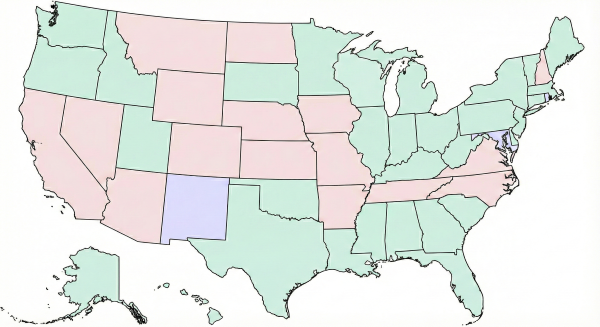
Green is AT&T, Pink is Verizon, and Purple is T-Mobile.
Image: WhistleOut
Wondering which carrier has the best coverage in your state? We’ve done the research and mapped them all out. Search for your state in the dropdown box below:
- Alabama
- Alaska
- Arizona
- Arkansas
- California
- Colorado
- Connecticut
- Delaware
- Florida
- Georgia
- Hawaii
- Idaho
- Illinois
- Indiana
- Iowa
- Kansas
- Kentucky
- Louisiana
- Maine
- Maryland
- Massachusetts
- Michigan
- Minnesota
- Mississippi
- Missouri
- Montana
- Nebraska
- Nevada
- New Hampshire
- New Jersey
- New Mexico
- New York
- North Carolina
- North Dakota
- Ohio
- Oklahoma
- Oregon
- Pennsylvania
- Rhode Island
- South Carolina
- South Dakota
- Tennessee
- Texas
- Utah
- Vermont
- Virginia
- Washington
- West Virginia
- Wisconsin
- Wyoming
How we analyzed each carrier’s coverage
Our coverage analysis is underpinned by extensive first-hand testing and supplemented by third-party research. Our team evaluates wireless networks based on the following:
- Coverage area: We analyze our proprietary coverage maps to determine each carrier’s network coverage. While one carrier may offer the largest coverage area within a state, we also look at specific cities and regions to determine which coverage is strongest for all users.
- Data speeds: Our experts venture out into the field to test each network, focusing on the download speeds and signal strengths for 4G LTE and 5G networks. This gives us an accurate reading of the value each network offers users in the real world.
- Network availability: 4G LTE coverage and 5G coverage offer different benefits for users. We balance the benefits of both to determine what networks will be most useful in specific locations and situations.
- Third-party research: We incorporate additional third-party data into our analysis. Speed test data from other publishers, the FCC, and online user reports supplement our findings to give users a balanced understanding of each network’s strengths and weaknesses.
In our work reviewing wireless carriers, we’re constantly updating our coverage experiences and testing results. Additionally, we continually monitor our coverage maps and make adjustments as networks expand their 4G LTE and 5G networks.
Max McCaskill
Sr. Staff Writer

Find a better phone plan
Thousands of cell phone plans unpacked. All the facts. No surprises.


.png?w=280&h=280&usm=20&usmrad=0.8&fit=crop "Best Cell Phone Deals for June 2026: Get the New iPhone 17 for Free")