Verizon is one of the first providers to offer 5G internet for your home in the United States. Big Red's 5G Home Internet service promises typical download speeds of 300Mbps, but if you live near a 5G tower, you could get up to 1Gbps. Moreover, it doesn't tie you into a lengthy contract and only costs $35/month if you bundle it with an unlimited data plan.
You should consider Verizon 5G internet for your home if you live in a city with 5G coverage. It is a pricier option, but you can save by bundling your wireless home internet with a Verizon phone plan. However, since Verizon’s 5G network is very limited, opting for traditional fiber broadband (like Verizon FiOS) is a great second choice.
What is Verizon 5G Home Internet?
Verizon 5G Home Internet service brings the internet into your home through a cellular router that allows any device with Wi-Fi connectivity to access the web. However, unlike a fiber or DSL network you get via a cable network to your home, Verizon Home Internet connects directly to Verizon's 5G cellular network via radio waves that send and receive data. Hence, the emerging term "mobile broadband." You may already have a phone plan with Verizon (and access to their 5G network), so you can save on your 5G Home Internet plan with myPlan bundling.
|
Verizon

myPlan + 5G Home
$35/mo
with AutoPay and any Verizon mobile phone plan
|
|
Verizon
5G Home
$50/mo
with AutoPay
|
How fast is Verizon 5G Home Internet?
Verizon 5G Home Internet customers can expect typical download rates of 300 Mbps, but they can go up to 1 Gbps depending on where you live. We’ve clocked Verizon’s 5G UW at speeds over 800 Mbps. That's on par with the average fiber internet speeds, which have been the fastest on the market until now. Verizon 5G Home Internet is fast enough to stream your favorite Netflix show or casually game online.
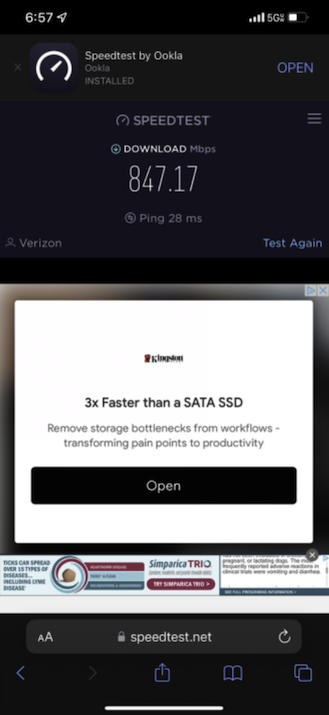
Image: Angelo Iluma
Verizon can deliver these speeds because it uses mmWave 5G, marketed as “Verizon 5G Ultra Wideband,” which is the fastest 5G standard currently available in the U.S. Other providers, like T-Mobile, have leaned toward sub-6GHz 5G because it's more readily available. However, it’s not quite as quick—although it does have a greater ability to travel through obstacles, such as buildings, for a wider reach.
Verizon has an added trick up its sleeve too: In addition to mmWave technology, it uses dynamic spectrum sharing, which allows it to combine 4G LTE and 5G bands for more demanding tasks like downloading content and video streaming. And if its 5G network goes down, it can fall back on 4G LTE connectivity.
Compare Verizon 5G Home Internet plans
| 5G Home | 5G Home Plus | 5G Home Ultimate | |
|---|---|---|---|
| Price | $50/month | $60/month | $75/month |
| Autopay discount | $10/month | $10/month | $10/month |
| Download speeds | 100 Mbps | 300 Mbps | 300 Mbps |
| Upload speeds | 10 Mbps | 20 Mbps | 20 Mbps |
| Typical latency | < 30 ms | < 30 ms | < 30 ms |
| Contract | None | None | None |
| Price lock | 2-years | 3-years | 3-years |
| Bundle pricing | From $35/month | From $55/month | From $60/month |
| Learn More | Learn More | Learn More |
Verizon offers various 5G internet plans starting at $50/month. But, with autopay and bundling discounts, you can pay as little as $35/month.
|
#1
|
Verizon
5G Home
$50/mo
with AutoPay
|
|
#2
|
Verizon
5G Home Plus
$60/mo
with AutoPay
|
|
#3
|
Verizon
5G Home Ultimate
$75/mo
with AutoPay
|
Verizon 5G Home Internet availability
Because Verizon 5G Home Internet operates on the ISP’s Ultra Wideband 5G network, its availability is pretty limited. Why? As mentioned, Verizon uses mmWave 5G technology to power its Ultra Wideband 5G network. These types of waves can’t travel nearly as far as those on, say, the 4G LTE spectrum or even the low-band 5G spectrum of its nationwide 5G network. As such, you need to be very near one of Verizon’s mmWave 5G towers to access that kind of 5G in your home. The map below shows which areas have the most 5G coverage from Verizon.
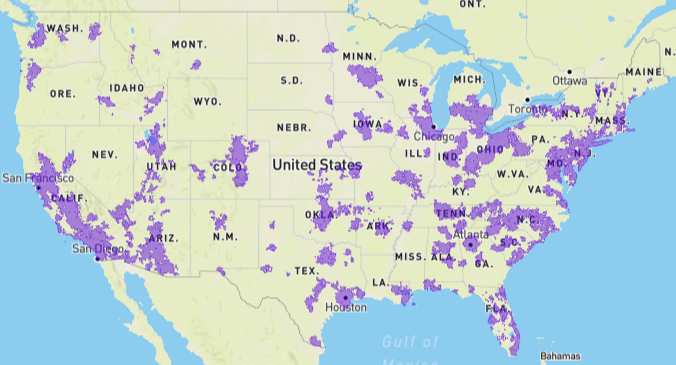
Image: WhistleOut
Currently, Verizon 5G Home Internet is available in select areas within specific U.S. cities, including:
- Phoenix and Tucson, AZ
- Los Angeles, CA
- San Francisco, CA
- Denver, CO
- Miami, FL
- Atlanta, GA
- Chicago, IL
- New Orleans, LA
- Charlotte, NC
- Las Vegas, NV
- Cleveland, OH
- San Antonio, TX
- Salt Lake City, UT
- Seattle, WA
Using our internet search tool or Verizon's availability checker, you can quickly determine if your neighborhood has access to Verizon's 5G home internet offerings.
Verizon 5G Home Internet compared
Verizon 5G Home Internet vs. T-Mobile, Starry, AT&T
| Provider | Speed | Data | Monthly cost | Perks |
|---|---|---|---|---|
| Verizon 5G Home Internet | 300Mbps typical; up to 1Gbps | Unlimited |
$50/month $35/month Verizon phone plan |
Bundling discounts |
| Starry 200 | Up to 200Mbps | Unlimited | $50/month | No installment fee |
| T-Mobile Rely Internet | 72-245Mbps | Unlimited | $50/month | No annual contract |
| AT&T Internet Air | 75-225Mbps | Unlimited | $60/month |
Verizon may be more expensive, but it offers the fastest speeds. If you don’t already have a cell phone plan, Verizon is the highest-priced option. However, it's significantly faster than both T-Mobile Rely Internet and Starry 200, thanks to its Ultra Wideband (mmWave) technology. By contrast, Starry’s unlimited home internet offers just 200Mbps, and T-Mobile only guarantees you at least 25Mbps of speed on their low-band 5G network, though 100Mbps is average for most customers. Although Verizon speeds are unmatched, Starry or T-Mobile could be good alternatives if Verizon’s 5G network isn't available where you live.
|
AT&T

Internet Air
$48/mo
Paperless billing required. Plus taxes & fees. Limited availability. May not be available in your area.
|
|
T-Mobile

Rely Internet
$50/mo
5 year price guarantee. With AutoPay. Guarantee exclusions like taxes and fees apply.
+ $35 Upfront
|
|
Verizon
5G Home
$50/mo
with AutoPay
|
AT&T Internet Air is also a 5G internet competitor, but it's not a fair competition due to Verizon's higher speeds and greater availability. Internet Air is only available for customers living in select cities who can't hook up to AT&T's fiber network. Most customers will find Verizon 5G Home more accessible.
Check out our Verizon vs. T-Mobile 5G home internet guide or our Verizon vs. AT&T Internet Air guide for the full rundown of where Verizon stands in the 5G Home Internet space.
Verizon 5G Home Internet vs. Verizon FiOS
| Service | Connection | Speed | Data | Price | Perks |
|---|---|---|---|---|---|
| Verizon 5G Home Internet | 5G | 300 Mbps typical; up to 1 Gbps | Unlimited | From $50/mo. $35/mo. w/ phone plan |
5-year price guarantee No data limits or annual contracts |
| Verizon FiOS | Fiber | Up to 940 Mbps | Unlimited |
From $49.99/mo. $24.99/mo. w/ phone plan |
No annual contracts 5-Year price guarantee |
FiOS and 5G Home Internet have no data caps
Both Verizon FiOS and 5G Home Internet are excellent choices if you want a super-speedy connection without worrying about going over your monthly data allowance. Each service offers truly unlimited data, meaning you’ll have 24/7 access without Verizon throttling your speed when you reach a certain amount.
Verizon FiOS is faster than Verizon 5G Home Internet
FiOS and 5G Home Internet provide speeds up to around 1 Gbps, but your speeds will be consistently higher with a fiber connection. 5G Home Internet works like FiOS inside your home in that the connection is distributed over Wi-Fi, so any Wi-Fi device can connect to it. A 5G signal is used only between the router and your closest Verizon 5G cell tower. However, since 5G Home Internet depends on Verizon’s 5G network, if there’s a gap in coverage in your area or lack of towers near you, your service would suffer or be unreliable.
Neither service is widely available as of yet since both FiOS and 5G Home Internet depend on relatively limited infrastructure. FiOS currently covers mostly metro and suburban areas of the northeast of the United States. In contrast, Verizon's 5G coverage is limited to specific cities within a handful of states with Verizon’s mmWave towers (as opposed to their nationwide mid-band 5G network).
FiOS has lower latency than Verizon’s 5G
The biggest difference between Verizon's 5G Home Internet and FiOS internet is how each brings the internet to your home. FiOS is a fiber internet connection with underground fiber-optic cables that connect to your home and transfer data. As mentioned above, Verizon 5G Home Internet uses its burgeoning Ultra Wideband cellular network to connect to your home via radio signals.
A traditional fiber connection is still considered to be more reliable than a completely wireless solution like 4G LTE or 5G. Fiber’s less susceptible to coverage issues, and in most cases, offers much lower latency. That means if FiOS is available in your area, it may be more suitable for you if you need the least possible lag for things like online gaming or livestreaming.
Verizon 5G Home Internet is more expensive than FiOS
FiOS is also likely to be a better fit for those on a budget, as they offer a variety of plans to meet your needs. Fiber plans start at $49.99/month with FiOS Internet 300/300, which drops to just $35/month if you also have a Verizon Unlimited phone plan. FiOS' fastest Gigabit Internet plan tops out at $89.99/month (or $64.99/month for cell subscribers).
One slight advantage to 5G Home Internet is that, because it doesn't require a fiber connection, there's no need for a technician to visit your home to get you up and running. Which also means there’s no added installation fees. You can set it all up yourself (and save $100) simply by turning on the router, and it's ready to go. However, an optional pro setup is available if you wish.
Is Verizon 5G Home Internet worth it?
Verizon 5G Home Internet is an excellent, albeit expensive, high-speed internet option… if you happen to be in one of its extremely limited service areas. Since making its debut in late 2018, the service has received glowing reviews, particularly for its speed. Its biggest drawback is its minuscule coverage footprint, though access continues to expand.
It’s not the most budget-friendly internet option if you aren’t already a Verizon wireless customer, especially since plenty of other fiber and cable internet plans offer similar average speeds for far less in price. But if you’re already a Verizon fan and you have Ultra Wideband 5G in your area, it’s absolutely worth trying out.
Pros and cons of Verizon 5G Home Internet
Pros:
- Super-fast plans with lots of bandwidth
- Discounts for Verizon wireless customers
Cons:
- Very pricey compared to similar speeds from other ISPs
- Extremely limited availability
Jessica Santero
Staff Writer

Find a better internet plan
Enter your address to find the best internet providers available in your area.


.png?w=280&h=280&usm=20&usmrad=0.8&fit=crop "T-Mobile AWAY Plan: Mobile-friendly internet launches for travelers and nomads")